Veiled Glass

Production

How Veiled Glass will be made: one practical room in a Singapore studio, two shoot days, and AI and VFX to build the city around it. This is the pre-production packet, minus the spoilers.

LIVE HUMAN OPERATOR SIGNATURE REQUIRED.

Rest the cursor on the pad, or press and hold. Enter works too.

Listening…

On this page

01 Approach

One room, then the city

Think of the interrogation scenes in The Matrix, Mission: Impossible, Cure and Ex Machina, rolled into one. I want a grounded, tense film where small changes in behavior make us question the room. We start with controlled frames and move closer as trust breaks down. Matte surfaces, worn stone and restrained lighting keep the future believable.

I’ll shoot over two days in a Singapore studio, with a minimal practical set and AI to extend the space and the effects. The performances, props and physical action still have to work in the footage we capture, so I’ll test the approach before committing to the final setup.

Written and directed by
Erik Magelssen
Genre
Psychological science-fiction noir
Runtime
11–14 minutes. 12 minutes 45 seconds planned, including credits
Format
English language. 2.39:1 anamorphic, 24 fps
Setting
Dubai, 2079
Shoot
Two days in a Singapore studio
Script
Development draft v4, 16 September 2026

Warm, flawed people against cold, perfect machinery

  • Dry tessellation

    Walls of tiny cubes that click into mashrabiya lattices. No liquid metal, no floating pixel-sand.

  • Sand and glass

    Glass is sand made rigid by heat. The storm is warmth and chaos. The glass is order. One grain scratching perfect glass is the flaw worth showing.

  • The pulse

    The room hums and keeps a beat.

  • Two hands

    Corin’s right hand shakes. Anything machine-made is perfectly still.

  • The one-way mirror

    A dark rectangle that turns out to be glass.

  • Silence

    Near the machine, the sound drops to nothing. Turn on the room tone and hover over the lattice to hear it.

What it is looking at

  • The Matrix, Mission: Impossible, Cure and Ex Machina: their interrogation scenes, rolled into one.
  • Blade Runner 2049: a detective investigating identity in a monumental future city.
  • True Detective, season one: two partners, years of trust, a case that breaks it.
  • Arrival: science fiction as a way into grief and memory.
  • Villeneuve’s architecture, and the quiet devastation of Wong Kar-wai.

Back to contents

02 Schedule

Counting back from the shoot

Dates are still open, so the plan counts back from the first shoot day. The two shoot days run back to back. Calendar dates follow once the cast, studio and crew are confirmed.

  1. Pre-production

    12 weeks to 3–5 days before

    Test the AI approach, collect quotes and lock the shooting script.

  2. Casting

    6 to 2 weeks before

    Self-tapes and a chemistry read, then confirm both leads and the supporting roles.

  3. Location scouting

    4 to 2 weeks before

    The DOP, the sound recordist and I check the studio’s noise, space, power and access.

  4. Rehearsals and design

    3 weeks to 5–7 days before

    A timed read, the key emotional beats, movement rehearsal, and props and wardrobe tests.

  5. Technical prep

    7–15 days to 3–5 days before

    Confirm camera, lighting and effects coverage, and a realistic setup plan.

  6. Final prep

    3–5 days to 1 day before

    Confirm packages and finishing scope; issue the call sheets.

Two shoot days

Day 108:30–18:30

The room

  1. Load in, dress, light and sound check. Block the interrogation.
  2. The room master, Corin and Maeve’s dialogue, and the evidence beats.
  3. Meal break.
  4. Consent, scan and evidence inserts.
  5. Kaden’s memory inserts, then wild lines and clean plates.
  6. Room tone. Secure the kit and verify the copies.

Day 208:30–18:30

Movement, plates and the alley

Movement rehearsal and coverage with the two officers, the effects plates, then the set is redressed as the sheltered alley. The rest of this day stays off the site.

Both leads work both days. Kaden has a short Day 1 call; the officers are needed on Day 2 morning.

shots planned
44
camera positions across two days
24–28
planned runtime, with credits
12:45

Before booking, the cast, crew, studio and finishing quotes have to fit within SGD 12,000, including contingency. We also need a timed script and a tested way to capture the action. If the setup time runs short, earlier access or overtime would mean a revised schedule and quote.

Back to contents

03 Budget

Budget under review

original target
SGD 6,000
existing ceiling, with finishing
SGD 12,000
revised estimate, with contingency
SGD 13,211–17,611

The revised estimate includes SGD 2,000–6,000 for AI tools and a 10 percent contingency. It exceeds the existing SGD 12,000 ceiling by SGD 1,211–5,611. Costs and scope need to be reconciled before booking.

Budget estimate, in Singapore dollars
CategoryBasisSGD
CastTwo leads, two officers and Kaden950
Production crewDOP, camera assistant, grip, sound, producing support, makeup and movement3,960
StudioTwo weekday 10-hour blocks at 400800
EquipmentLenses 200 and equipment gaps 100; camera loan expected300
Set props and wardrobeBorrowed and reused items and materials250
Meals and waterAbout 10 people × 2 days × 15300
TransportLocal, shared travel150
Insurance and venue chargesAllowance pending the venue’s requirements150
Editor polishPacing polish, final conform and basic grade800
Final soundDialogue clean-up, design, mix and master2,200
AI toolsCredits and tools; estimated range, to be checked in tests2,000–6,000
MusicLicense allowance50
Media and backupExtra storage100
Direct costs12,010–16,010
Contingency, 10 percent1,201–1,601
Total13,211–17,611

These are planning allowances, and I’ll confirm all-in quotes before committing. My producing, directing, set design, first edit and AI work carry no cash fee. The estimate assumes borrowed camera gear, reused furniture and existing studio walls.

I’ll keep the paid editor polish and sound finish in scope while negotiating the shoot costs. No discounts or contributions are assumed in this estimate.

Back to contents

04 Shot list

The first 16 shots

There are 44 shots in all. Dialogue runs through whole beats and shots share camera positions. These are the first 16, up to the scan; the rest stay off the site until the film is out.

WS wide · MS medium · MCU medium close-up · CU close-up · ECU extreme close-up · OTS over the shoulder. Locked means a fixed camera. Lenses in mm, full-frame equivalent.

Opening: the alley

Shots 01 to 03
ShotSceneFramingImage and actionSound
01S01WS 35 · lockedBoth leads reach the alley wall.Breath, distant wind. No triumph cue.
02S01CU 65 · lockedCorin’s relief drains. “It let us go.”A clear line and isolated breath.
03S01WS 35 · short push or cutMove into darkness; cut to the dark observation panel.The wind narrows into the room’s hum.

The interrogation

Shots 04 to 11
ShotSceneFramingImage and actionSound
04S02AWS 35 · lockedThe room’s geography: Corin, the table and the door.Room tone; restraint handling.
05S02AECU 85 · lockedHis human right fingers tremble; the left forearm is restrained.Skin and table texture; a fine cuff click.
06S02ACU 85 · lockedThe right-temple implant. An intrusive memory hits Corin.Breath and a restrained pulse.
07S02AMS 50 · lockedThe door opens and Maeve enters. It closes slightly too early.The door closing, and her stopped breath.
08S02AMCU 65 · lockedMaeve waits for an answer, then presents Kaden.The full, clean interrogation side.
09S02ACU 50/85 · locked insertsKaden alive; the blue cup; a separate blade impression, no contact.Cup sound; a short memory layer.
10S02AMCU 65 · lockedCorin denies, then admits hiding the memories.A complete emotional take; no music playback.
11S02ATwo-shot 50 · lockedShe challenges his decision to keep her uninformed.Overlap-safe dialogue and pauses.

The evidence

Shots 12 to 16
ShotSceneFramingImage and actionSound
12S02BOTS 50 · lockedCorin spots the clock discrepancy; Maeve checks the second source.Keep the investigation conversational.
13S02BInsert 85 · lockedThe 10:47 reflection against the 11:23 record, then the matching shadow.Small interface sounds, added later.
14S02BMS 50 · lockedMaeve reaches out; the hum eases before her touch.Record a clean action; offset the hum in post.
15S02BCU 85 · lockedMaeve realizes the room is ahead. Corin reads it differently.An exact pause before her line.
16S02BECU 85 · lockedA cube forms in Corin’s left palm.A granular scrape; a clean plate.

Shots 01–03 are filmed with the alley scenes on Day 2, so the opening matches what follows.

Back to contents

05 Storyboards

Boards

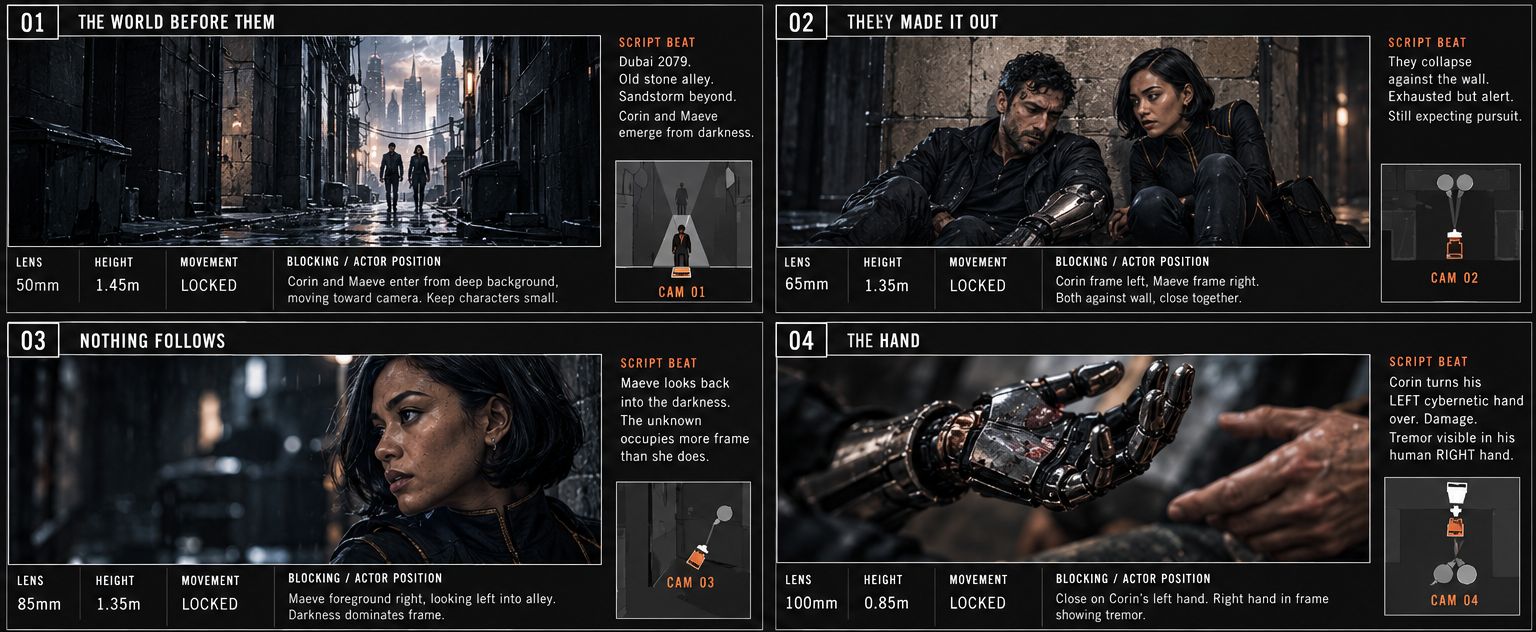
Storyboard sheet, panels 01 to 04: the city before them, the partners making it out, the alley and Corin’s hand, with lens and blocking notes.
Storyboard The alley, panels 01–04.
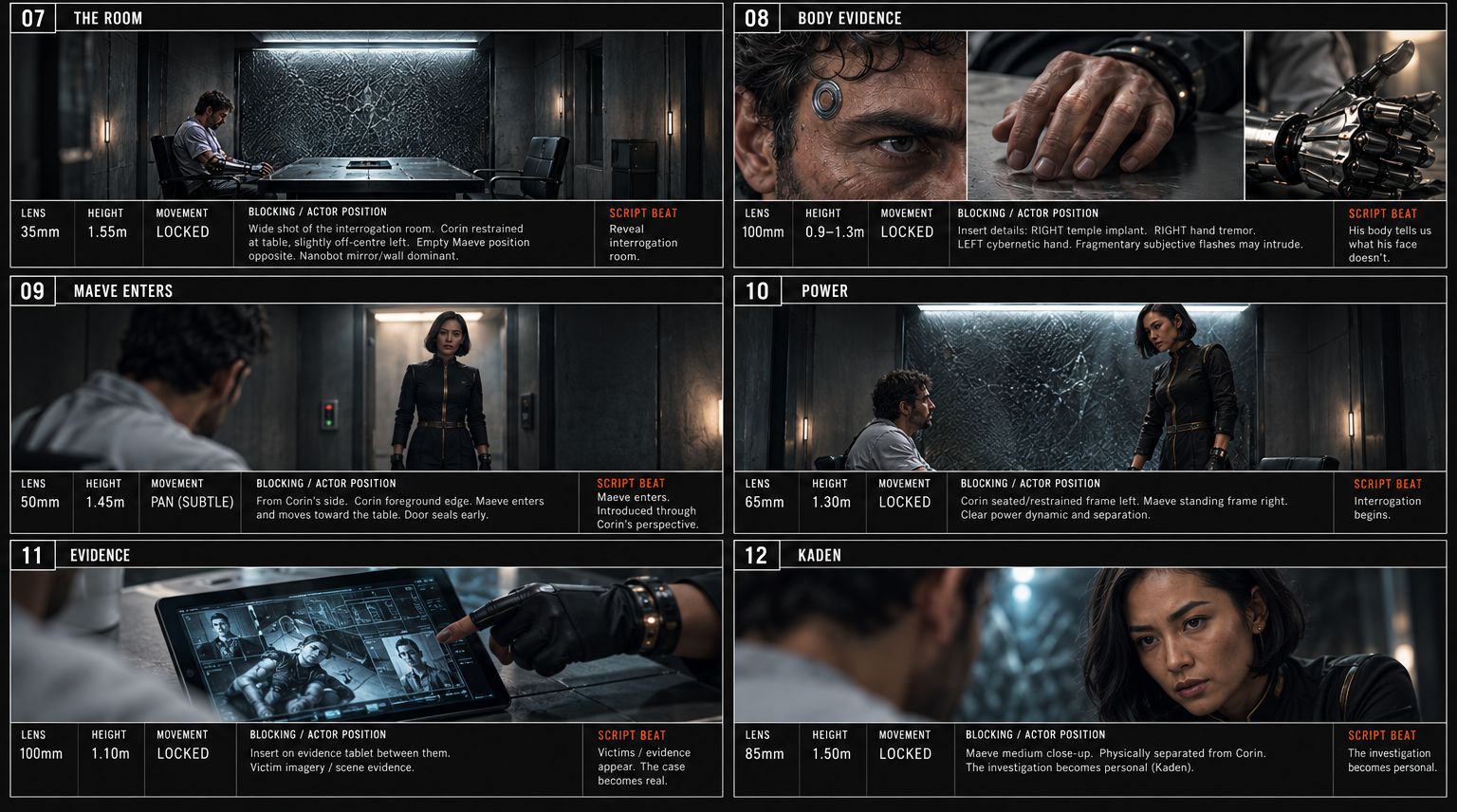
Storyboard sheet, panels 07 to 12: the room, the evidence, Maeve entering, the wall, the evidence screen and Kaden, with lens and blocking notes.
Storyboard The interrogation room, panels 07–12.
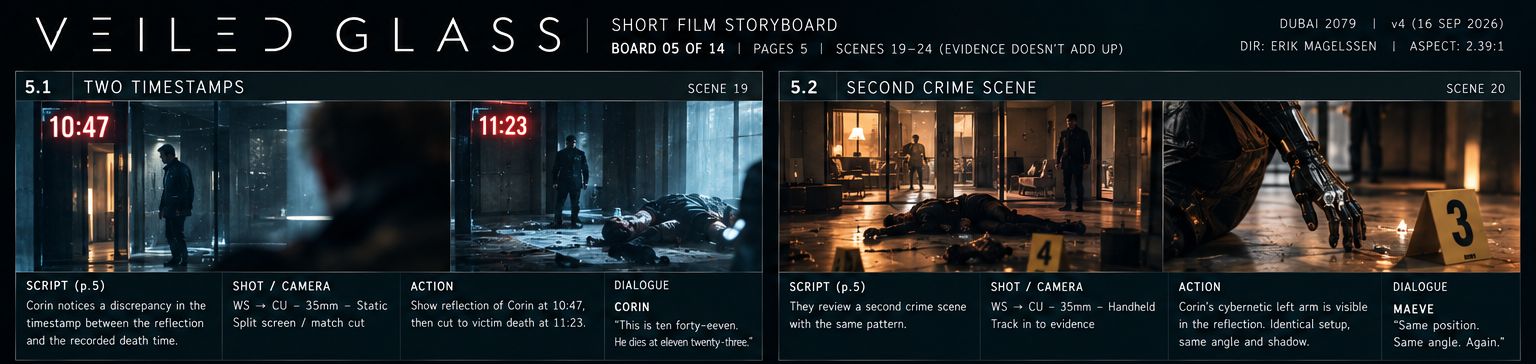
Storyboard strip: two timestamps, 10:47 and 11:23, and a second crime scene.
Storyboard The evidence: two timestamps and a second scene.
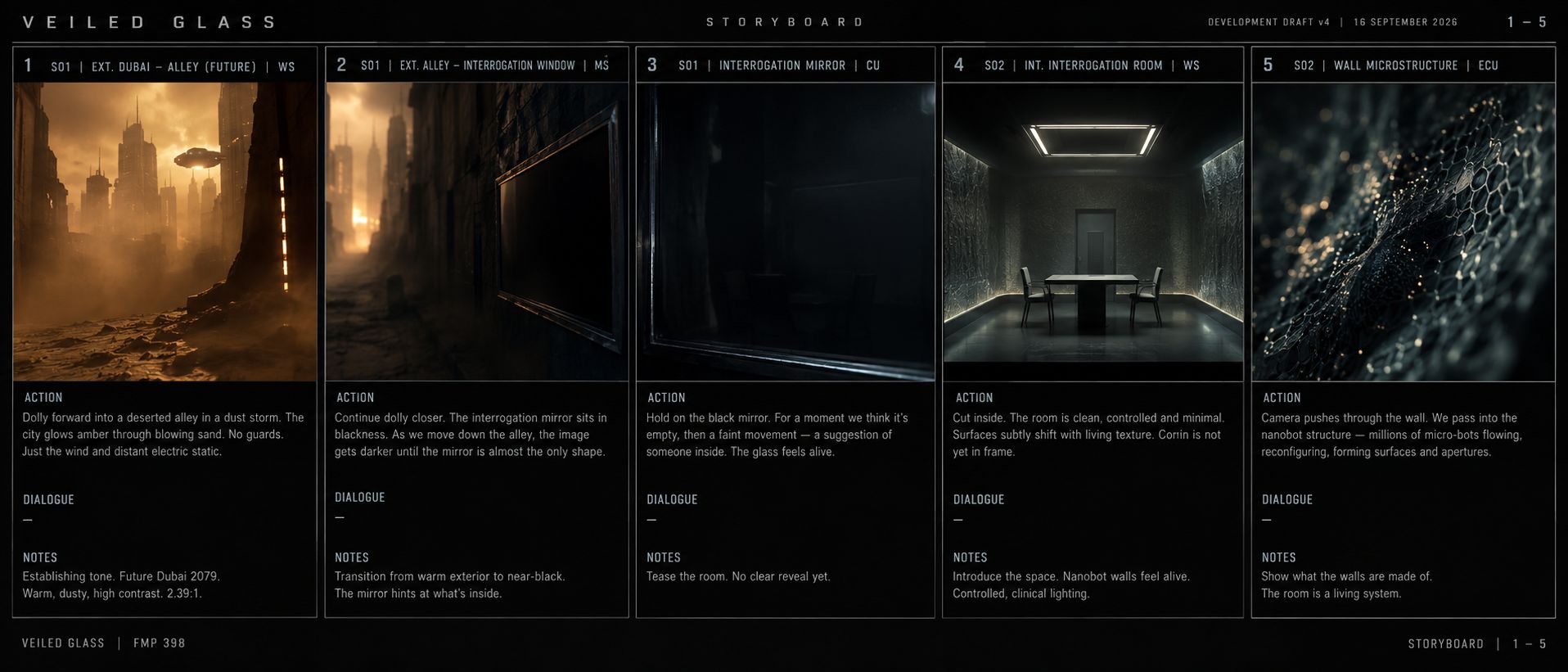
Storyboard sheet in five panels: from the storm, through the dark, to the one-way mirror and the room.
Storyboard From the storm, through the mirror, into the room.

Boards made with AI image tools from the shot list.

Back to contents

06 Design and locations

One studio, every location

We need a quiet Singapore studio with usable walls or flats, enough camera distance and controllable light. The venue is still to be confirmed; the plan allows SGD 800 for two weekday ten-hour blocks. Every screen location is built inside it.

Floor plan of the interrogation room A room about 6.5 by 4.8 meters. A one-way mirror runs along the far wall and a practical door opens out of the right wall. A table sits in the middle with Corin on the far side and Maeve on the near side. The near side is open for the camera: camera A, at the left, covers Corin and the master; camera B, at the right, covers Maeve. One-way mirror Door Table Corin Maeve A B Open camera side 6.5 m 4.8 m
A concept layout, about 6.5 × 4.8 m before camera and working space. A covers Corin and the master; B covers Maeve. It will be adjusted to the measured studio.
Locations
LocationSettingNeeds
Interrogation roomINT · nightTable, two chairs, a dark observation panel and a door. Quiet for dialogue, with room for movement coverage.
Sheltered alleyEXT · nightA studio wall return with stone texture and a narrow light from the exit.

Studio checks

  • Parking and loading. Access and delivery times.
  • Permissions. Studio filming approval, and any limits on set dressing, action or props.
  • Noise. Test dialogue with the air-conditioning on and off.
  • Power. The available circuits and the lighting load.
  • Weather. None: the shoot is indoors, and light, sound and VFX make the storm.
  • The rest. Setup and strike access, overnight storage, a changing space and clear exits.

Look and palette

I’ll handle the basic set design. We’ll borrow or reuse furniture and build only the pieces we need for performance and contact.

  • Matte charcoal
  • Muted sand
  • Worn stone
  • Natural skin
  • Warm practical light
Sets
SetPalette and dressingKey props
Interrogation roomMatte charcoal and muted sand; restrained institutional lightSteel-look table, two chairs, observation panel and door
Sheltered alleyWorn stone and muted sand; a narrow light from the exitA textured wall return, reused from the studio set
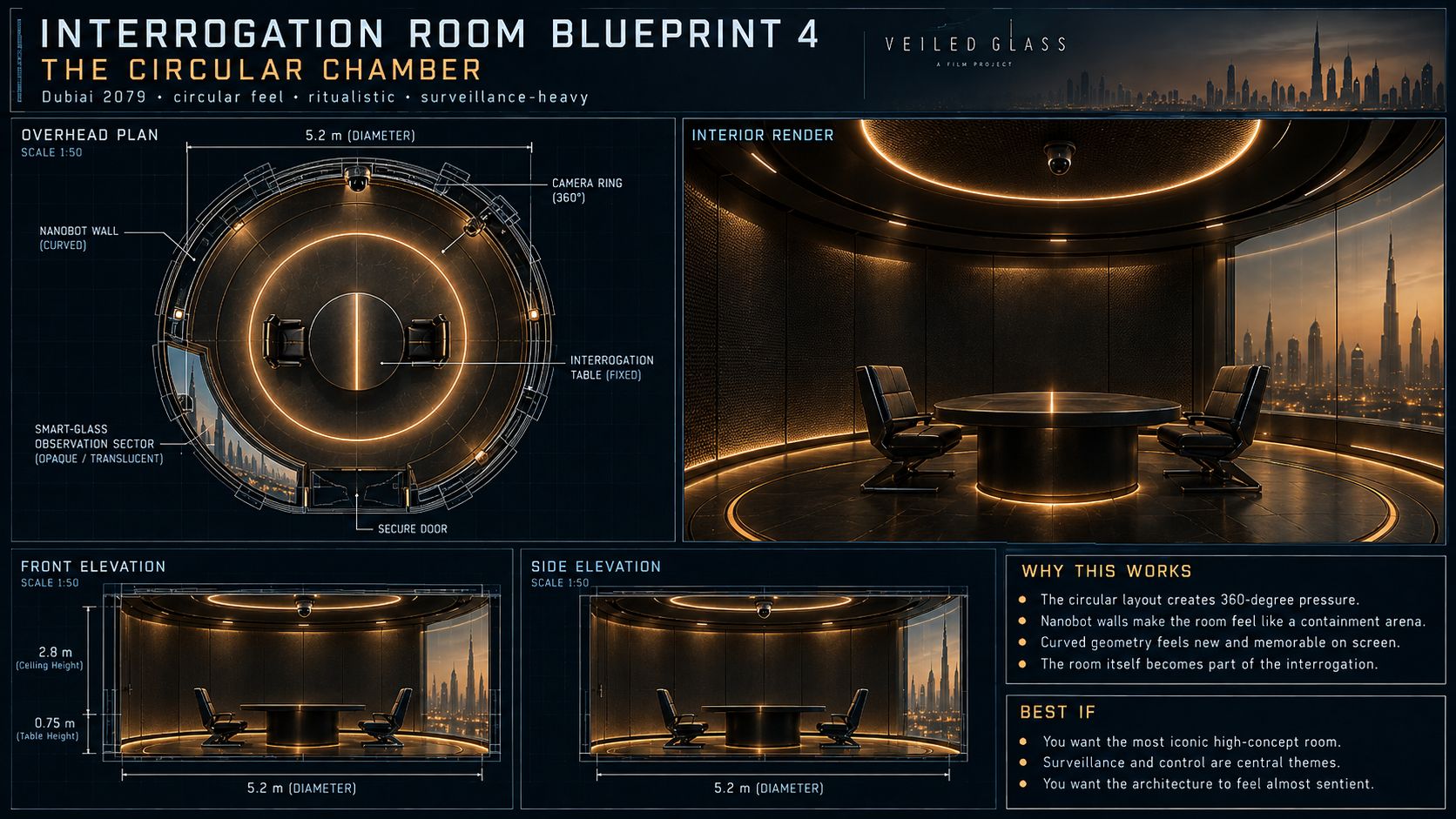
Design board for a circular interrogation chamber: overhead plan, elevations and an interior render above a city.
Design study Room study: the circular chamber.
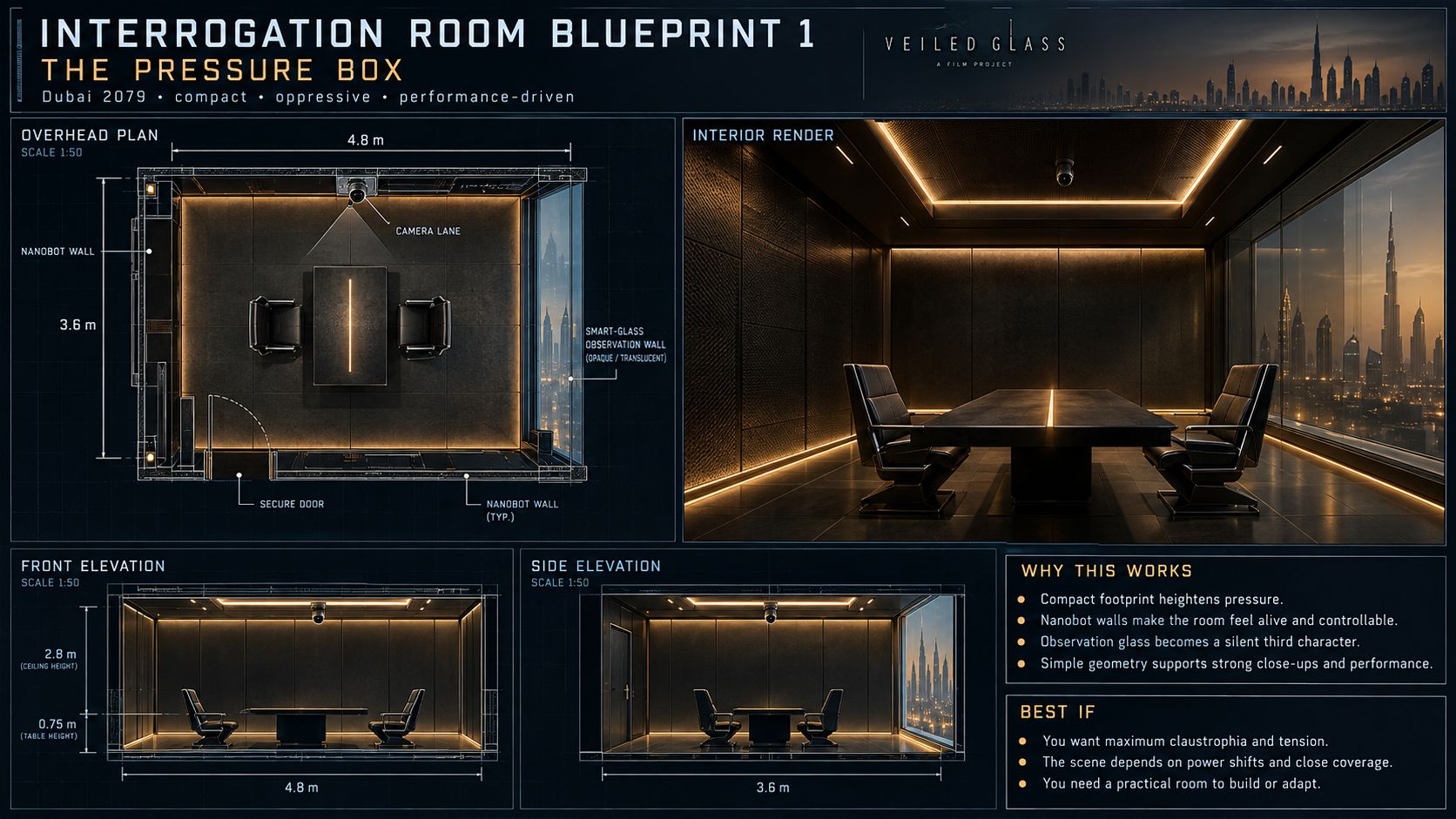
Design board for a compact rectangular interrogation room: overhead plan, elevations and an interior render.
Design study Room study: the pressure box.

Props

Props
PropSource or method
Table and two chairsBorrowed, or the studio’s own furniture.
RestraintA safe sleeve with a real quick-release catch.
Left armA test sleeve or cover, or the natural arm as reference for AI treatment.
Right-temple implantA small adhesive appliance, tested with makeup.
Maeve’s wrist interfaceAn adapted wrist band, with flat graphics or tablet inserts.
Evidence and scan graphicsPortraits, timestamps, memories and signature screens, made in advance.
Blue cupA borrowed cup with a painted chip.

Wardrobe and continuity

Wardrobe
CharacterCostume
CorinWorn, dark civilian clothes in a matte fabric that works with the left-arm treatment.
MaeveFunctional dark tailoring, with free movement and access to her wrist.
OfficersMatching dark uniforms and visors, borrowed or adapted.
KadenSimple, neutral civilian clothes.

Corin’s cybernetic arm stays on the left, his implant on the right temple and the tremor in his human right hand. Maeve’s interface is proposed for the right wrist, to be locked in rehearsal.

Back to contents

07 Casting

Chemistry first

I’ll cast the leads through self-tapes, a chemistry read and a rehearsal. The age ranges are a guide. Rehearsal time, fees, physical contact and the AI treatment of each performance are agreed before the shoot.

Casting
CharacterAge and performanceNeeds
CorinPlaying 30–45. A mixed Arab-British detective. Restrained fear.Both days. Tremor continuity, arm contact and matched takes.
MaevePlaying 25–40. Dark-skinned, observant and emotionally direct.Both days. The scan decisions, non-contact action and partner contact.
Two officersAdult performers with precise, repeatable movement. Officer 1 has a short line of authority.Day 2 morning: movement rehearsal and matched effects plates.
KadenA man in his early thirties. A brief, warm memory performance.Memory inserts and the evidence portrait. A short Day 1 call.

The priority is the leads’ chemistry and the change in trust between them. We’ll rehearse the withheld-memory exchange and the scan.

Back to contents

08 Camera and equipment

One borrowed camera, a small lens set

The DOP leads camera and lighting. I expect to borrow a Canon R5 C from the office and rent a small set of lenses. We’ll confirm the full package before booking; my iPhone is a backup that would also need testing.

Equipment
DepartmentEquipmentSource and status
CameraCanon R5 C, with power, media and monitoringOffice loan expected. Confirm permission, recording settings and power run time.
LensesA small set covering about 35–85 mm, full-frame equivalentRental allowance SGD 200. The DOP chooses after the studio visit.
SupportTripod; a simple slider if availableBorrowed or from the camera package. Repeatable frames for effects.
LightingSoft key, controllable hard light, a practical, flags and negative fillStudio inclusions or borrowed kit. Units and power agreed with the DOP.
GripStands, sandbags, clamps, cable protection and black fabricStudio or crew package. A modest, floor-based setup.
SoundMixer-recorder, boom and two lavaliersThe sound recordist’s package, subject to quote. Clean, isolated tracks.
MediaLaptop, card reader and two production drivesOwn or borrowed. SGD 100 for extra storage.
ReferencesColor and gray card, tape measure, phone stills and a lens logBorrowed or existing supplies.

Camera approach

We start with controlled, wider frames, then move closer as the evidence and the trust become unstable. Corin’s breath and right-hand tremor stay visible.

The ratio is 2.39:1, anamorphic. I’m proposing 24 fps, subject to a flicker test with the actual lights and screens. Makeup, dark materials and the arm treatment are tested in the same setup.

Effects references

Before the camera moves, we capture the matching empty set, actor reference stills and any contact inserts, and log lens, camera height, focus, exposure, white balance and light positions.

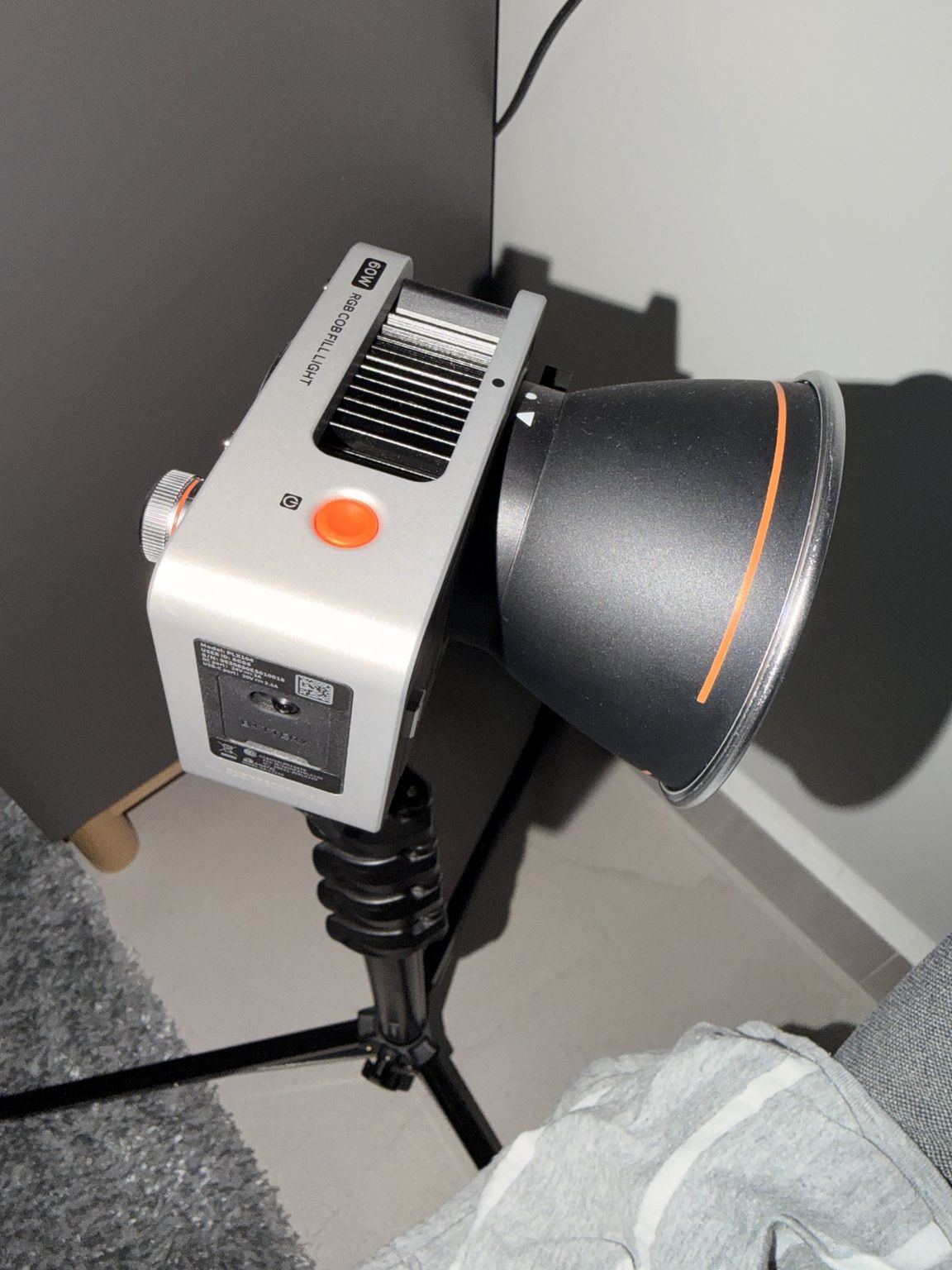
A small lamp with an orange dial on a light stand, set up in the corner of a room.
Equipment A practical light on test.

Back to contents

09 Sound and music

Hear the room first

Sound lets us feel the room before we understand it. We record clean dialogue with no room hum or music playing on set, then build the room’s behavior in post.

  • Dialogue and room tone

    The recordist captures boom and lavalier tracks, breath, the cuff and the chair. The room hum is built in post.

  • The predictive hum

    A clean reach and reaction, recorded with a silent cue. The sound designer makes the hum ease before Maeve touches the control.

  • Scan and memory layers

    The full dialogue, device handling and the cup, recorded on set. Scan tones and memory layers are built in post.

  • Alley wind

    Quiet tails on set. The sound designer adds wind and electrical ambience.

Music

A sparse score that leaves room for dialogue. Low strings and restrained electronic texture carry the tension, and a small human theme belongs to Corin and Maeve’s partnership. The opening holds that theme back.

I’ll check that each license covers the intended release before using a cue, and use AI-generated music only if its release rights can be cleared. The music allowance is SGD 50. The sound designer covers dialogue clean-up, Foley, ambience, music and a stereo mix, ideally with separate dialogue, music and effects stems.

Back to contents

10 AI and visual effects

A practical set, extended

I make the AI effects myself. Before the shoot, I’ll act out a short test at home with my planned Seedance 2.5 workflow, to check continuity, contact, repeatability, and the time and credits each usable shot needs.

Effects plan
EffectPractical or digital
Room, alley and stormPractical walls and contact surfaces; AI extends the texture, depth and storm. Matching empty plates, with camera and light references.
The cube and the left armPractical hand contact plus AI treatment. Palm detail tested, with the dialogue that depends on it kept in step.
Memory imageryActor reactions and cleared memory footage, with prepared flat graphics and AI memory layers.
Evidence screensExact graphics, made in advance, on a monitor or a composited screen. Timestamps must be legible.

A plate is matching footage used to build an effect: the empty background and separate actor reactions, recorded before the camera moves.

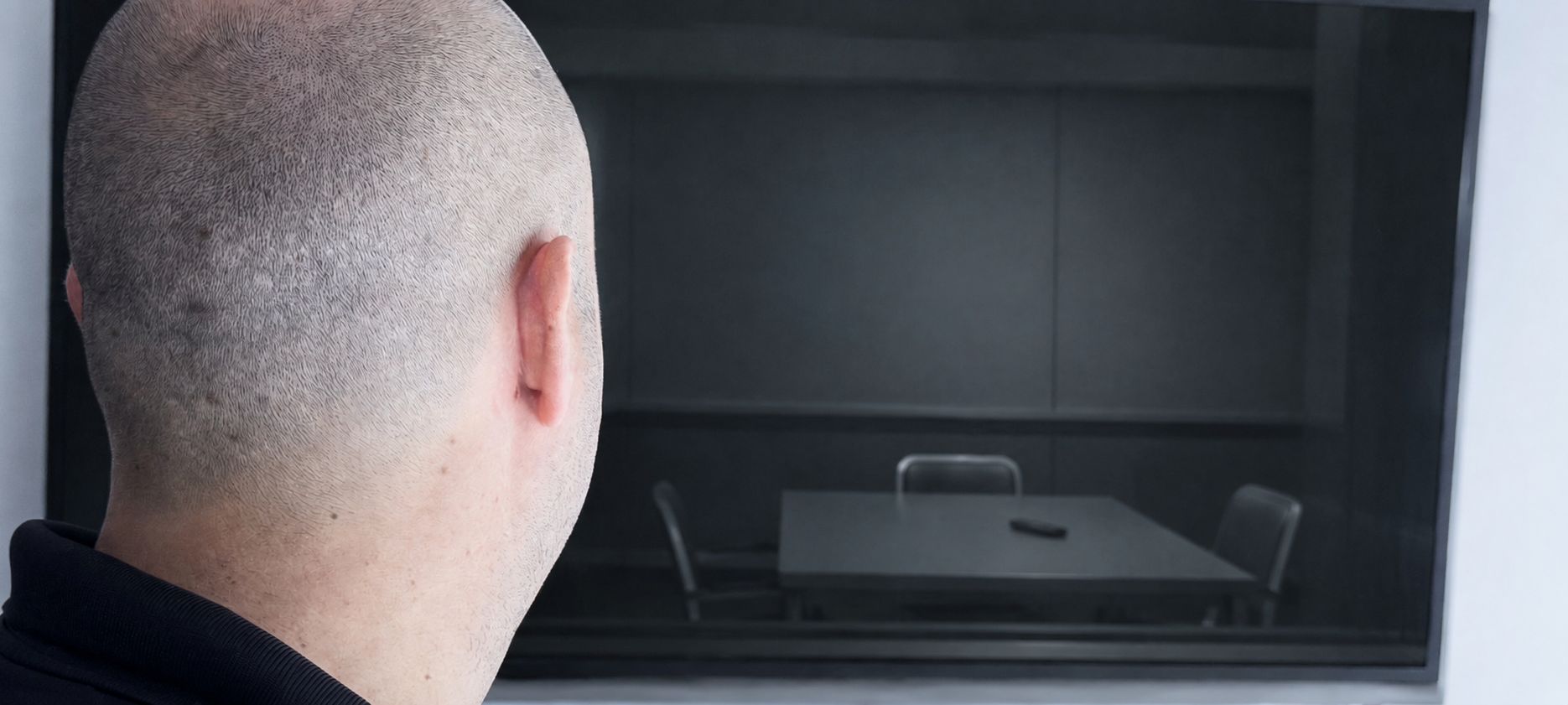
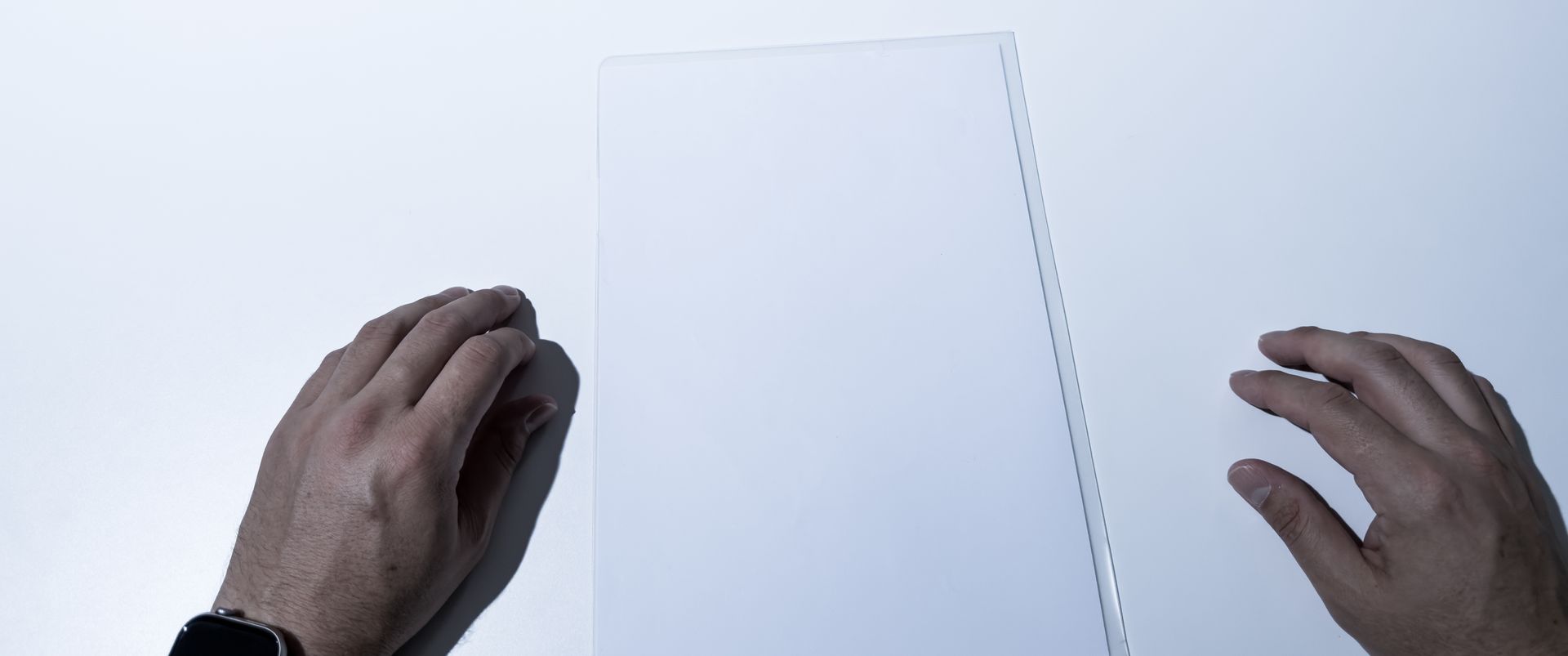
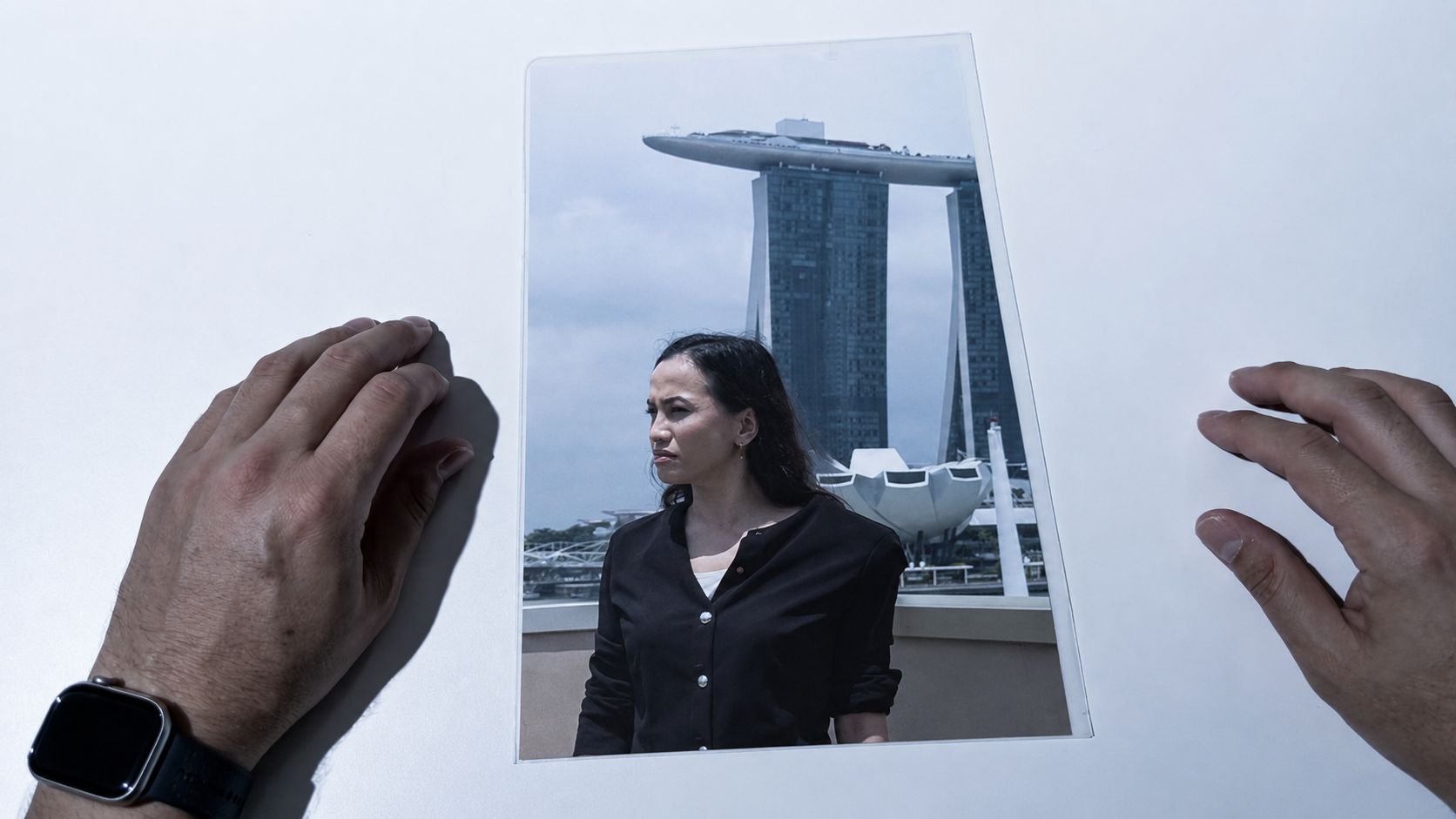
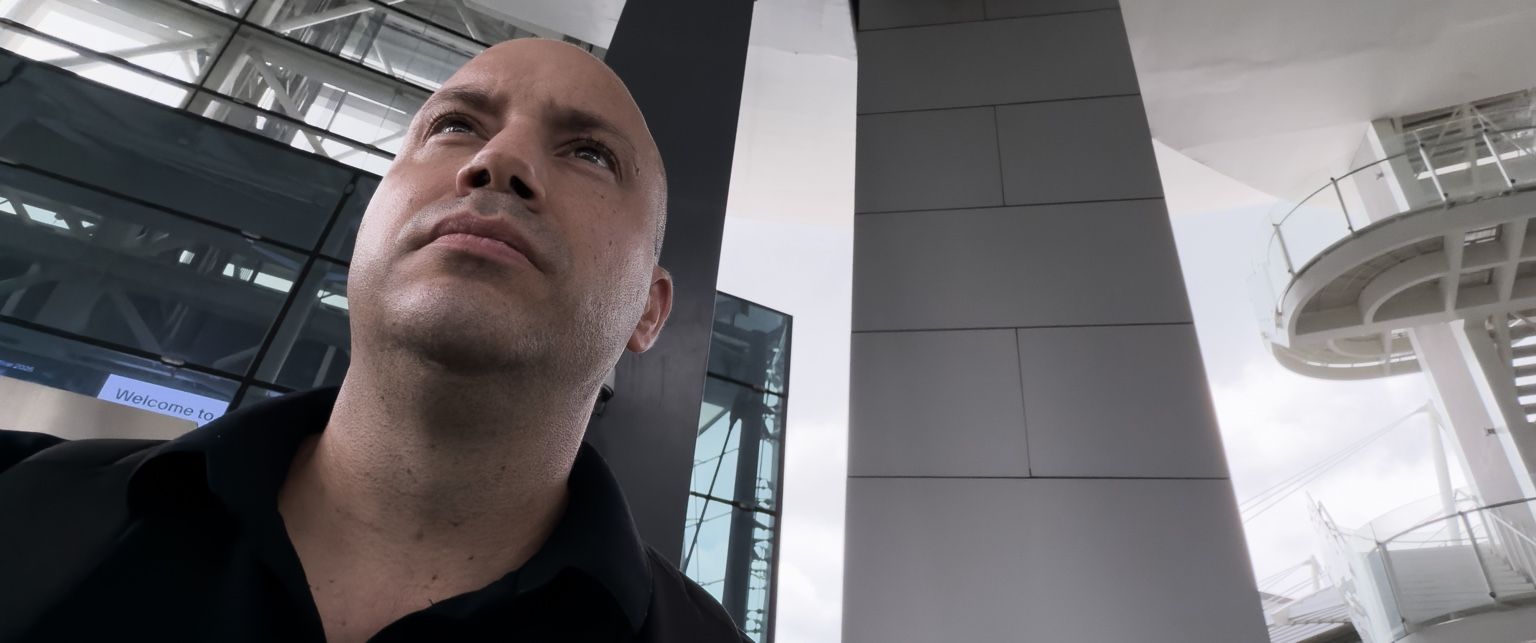
Tests: a photo, then an AI pass

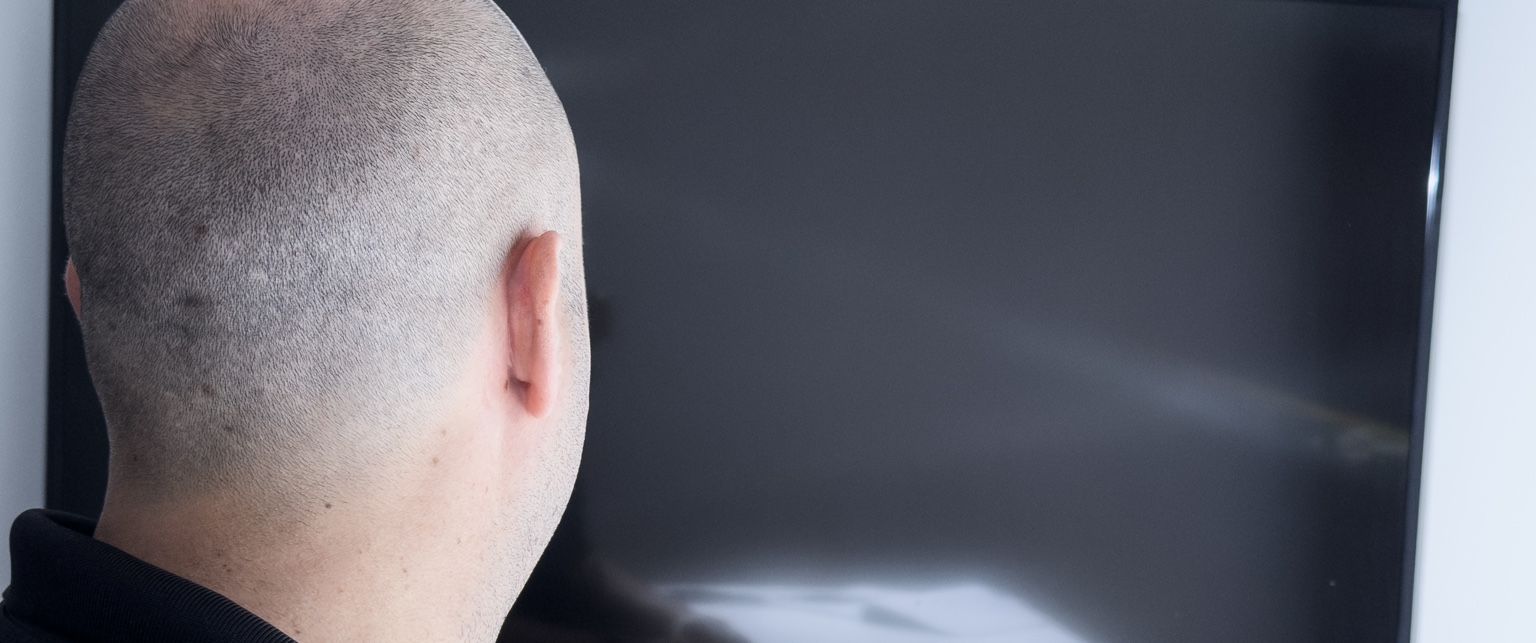
BeforeThe back of a man’s head as he watches a television in a living room.
AfterThe same man, seen from behind, looking through an observation window into an interrogation room.
A living-room TV becomes the observation window.
BeforeTwo hands holding a blank white card against a white table.
AfterThe same hands holding the card, which now shows a photograph of a woman on a city rooftop.
A blank card becomes an evidence photograph.
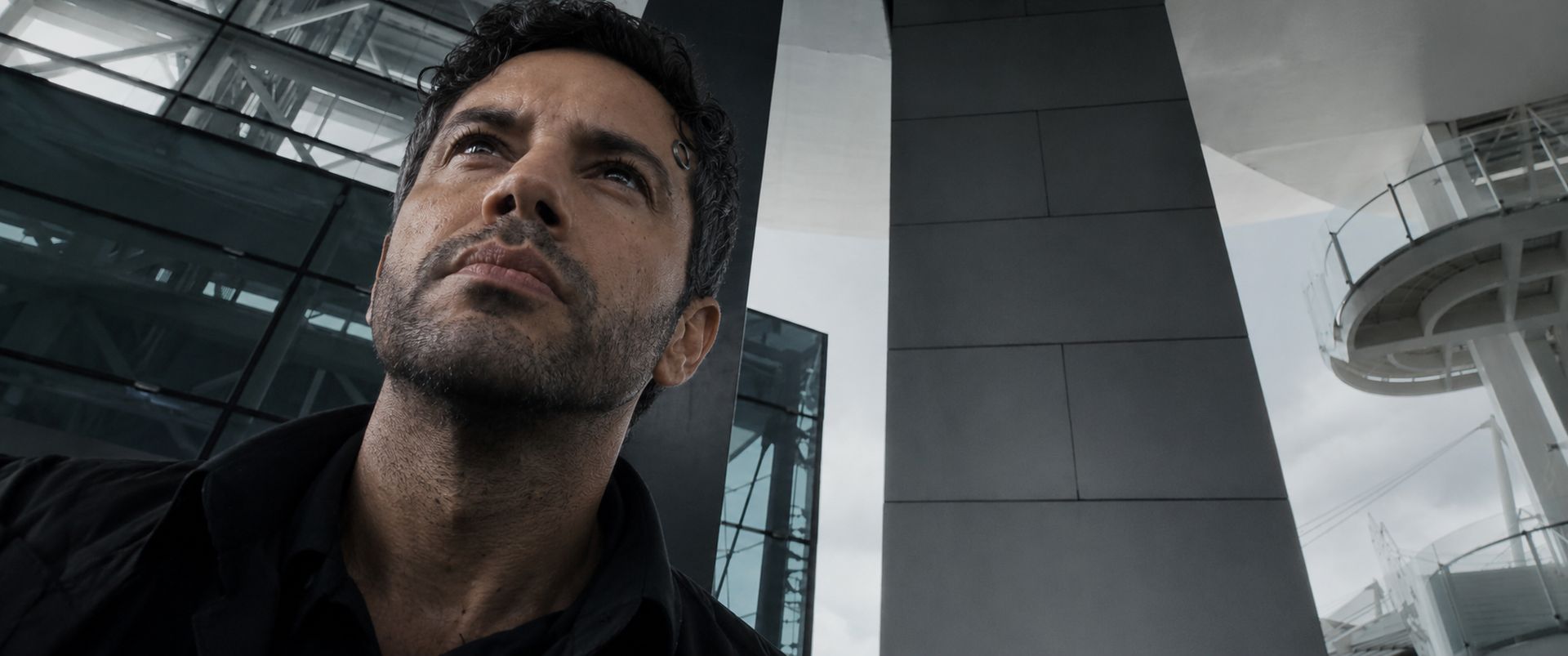
BeforeA man looking up from a low angle under a curved glass roof.
AfterThe same frame with a dark-haired man in his place, a small implant at his temple.
I stand in for Corin; the AI pass adds his hair and the temple implant.

This site’s concept art was made with AI image tools too. The scene behind each page title is drawn live in code.

Back to contents

11 Post-production

Thirty-five days to a finished film

I’ll build the first edit, then bring in an editor for pacing polish before the final AI pass. The windows count from the first shoot day. They’re estimates: the effects test and the course deadline set the final dates.

  1. Organize and sync

    Days 1–4

    Organize, sync and back up the footage. Original media stays intact.

  2. First picture edit

    Days 5–10

    The complete story and performance cut, with rough effects placeholders.

  3. Edit polish and lock

    Days 11–14

    With the finishing editor: settle pacing and shot lengths within 11–14 minutes.

  4. Music selection

    Days 11–14

    With the sound designer: choose cues and check the rights before the mix.

  5. AI VFX and screens

    Days 15–21

    Final effects and graphics. This window is revised once the tests are measured.

  6. Conform and color

    Days 22–25

    The finishing editor brings in the effects and grades, with my review and the DOP’s input.

  7. Titles and credits

    Days 22–25

    Final, readable titles and credits.

  8. Sound edit and mix

    Days 26–31

    Dialogue, Foley, effects, music and a stereo master with stems.

  9. Final export and QC

    Days 32–35

    A full check of the film, then the master, a viewing copy, captions and the archive.

Handoffs

The editor gets an organized project, relinkable media and a timecoded reference. The sound designer gets the locked picture and original sound files in an agreed interchange format.

The final review

Dialogue clarity, screen readability, arm continuity, stable AI faces and hands, and matching color across effects shots. The AI pass is the least certain part of the timeline, so it’s tested during prep.

Back to contents

12 Crew

Six on set

Six core people on set: the director, the DOP, producing support, a camera assistant, lighting and grip, and production sound. Makeup and movement specialists join the blocks that need them. Editing and sound design happen after the shoot.

Nobody is booked yet. I’ll confirm each person’s scope, availability and fee first.

Crew positions
RoleWhoResponsibilities
Producer and directorErik MagelssenProducing, casting, direction, script decisions and final approvals.
Production designErik MagelssenBasic set, props and wardrobe; continuity with producing support and makeup.
Director of photographyTo be confirmedCamera, lighting plan and visual continuity.
Producing support and ADTo be confirmedCalls, floor coordination, schedule, meals and continuity notes.
Camera assistantTo be confirmedCamera support, focus and lens changes, media and verified backups.
Lighting and gripTo be confirmedLighting setup, stands and flags, and practical support to the DOP’s plan.
Production sound mixerTo be confirmedDialogue, isolated tracks, room tone and sound reports.
MakeupTo be confirmed · short callsSubtle makeup and repeatable continuity states.
Movement specialistTo be confirmed · agreed blocksRehearsal and supervision of non-contact movement.
Picture editErik Magelssen, with a finishing editor to be confirmedMy first cut; the editor adds pacing polish, final conform, a basic grade and agreed revisions.
AI visual effectsErik MagelssenTests, effects, screen graphics and continuity review.
Final soundSound designer, to be confirmedDialogue clean-up, Foley, sound design, music, stereo mix and stems.

Back to contents